Posted on Tuesday 21st October 2025
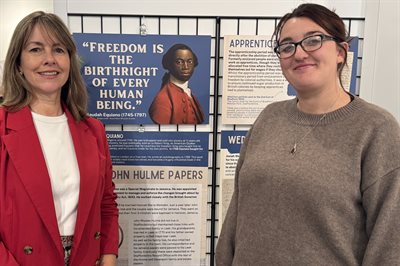
Councillor Hayley Coles visited the exhibition and curator Sophie Harris, encouraging everyone to come and explore Staffordshire's "rich past."
People are invited to view a new exhibition exploring Staffordshire and Slavery.
The exhibition, at the Staffordshire History Centre in Stafford, uses previously unseen letters, petitions and legal documents to highlight the impact of slavery on the county.
Before the outlaw of slavery in the early 19th century, the U.K. was an active participant in the transatlantic slave trade. While the legacy of slavery in port cities, such as Bristol and Liverpool, is well documented, the extent to which inland areas like Staffordshire profited from the practice is less understood.
Included in the exhibition is a series of letters written by a woman who lived on a Jamaican plantation in the mid-18th century to her mother in Stone, and documents relating to the county’s abolitionist movement. The historic archives include the role of women in slavery, and the movement to end it.
Led by abolitionists like Wilberforce, Equiano, and Clarkson, with support from churches and citizens, Britain was one of the first global powers to take legislative action against slavery. The Slave Trade Act of 1807 banned the transatlantic slave trade and the Slavery Abolition Act of 1833 began the process of freeing enslaved people across the British Empire, earlier than many nations.
To enable abolition, the government paid £20 million to slave owners, funded by a loan, repaid by generations of taxpayers. Sadly, those who had been enslaved received no direct compensation.
It’s a reminder of past injustices and slavery still exists in the world today. It is hoped that others will be inspired by the work of Wilberforce, Equiano, and Clarkson and other abolitionists to achieve the end of slavery across the globe.
Hayley Coles, Cabinet Member for Communities and Culture at Staffordshire County Council, said: “When we think about slavery, we usually think about the major ports and cities like Liverpool and Bristol, but slavery was present in most counties, including Staffordshire.
“Using our extensive archives, and help from researchers at Keele University, we’ve been able to paint a clearer picture on its impact on the county and its residents.
“Britain was one of the first European nations to ban slave trading nearly 200 years ago. We should be proud of what our county has become and the progress we have made. This is one of many brilliant exhibitions taking place at the new Staffordshire History Centre and I’d encourage everyone to visit and learn more about our county’s rich past.”
The exhibition has been funded by the National Lottery Heritage Fund and developed in partnership with Keele University.
The exhibition runs until 6 December. Further details are available on the Staffordshire History Centre's website.
WATCH: Sophie Harris, who designed and installed the exhibition, and councillor Hayley Coles at the exhibition here.