ESAS regularly update the SLN however it is the responsibility of education professionals to ensure that the information (guidance, resources, posters etc) that are used are up to date and relevant
Specific safeguarding areas
Explore statutory and non-statutory guidance and resources for particular safeguarding areas including child sexual abuse, domestic abuse, fabricated or induced illness and perplexing presentations (FII/PP), extremism, FGM, harmful sexual behaviour (HSB), mental health, online safety, parental conflict and other topics
Neglect and the graded care profile
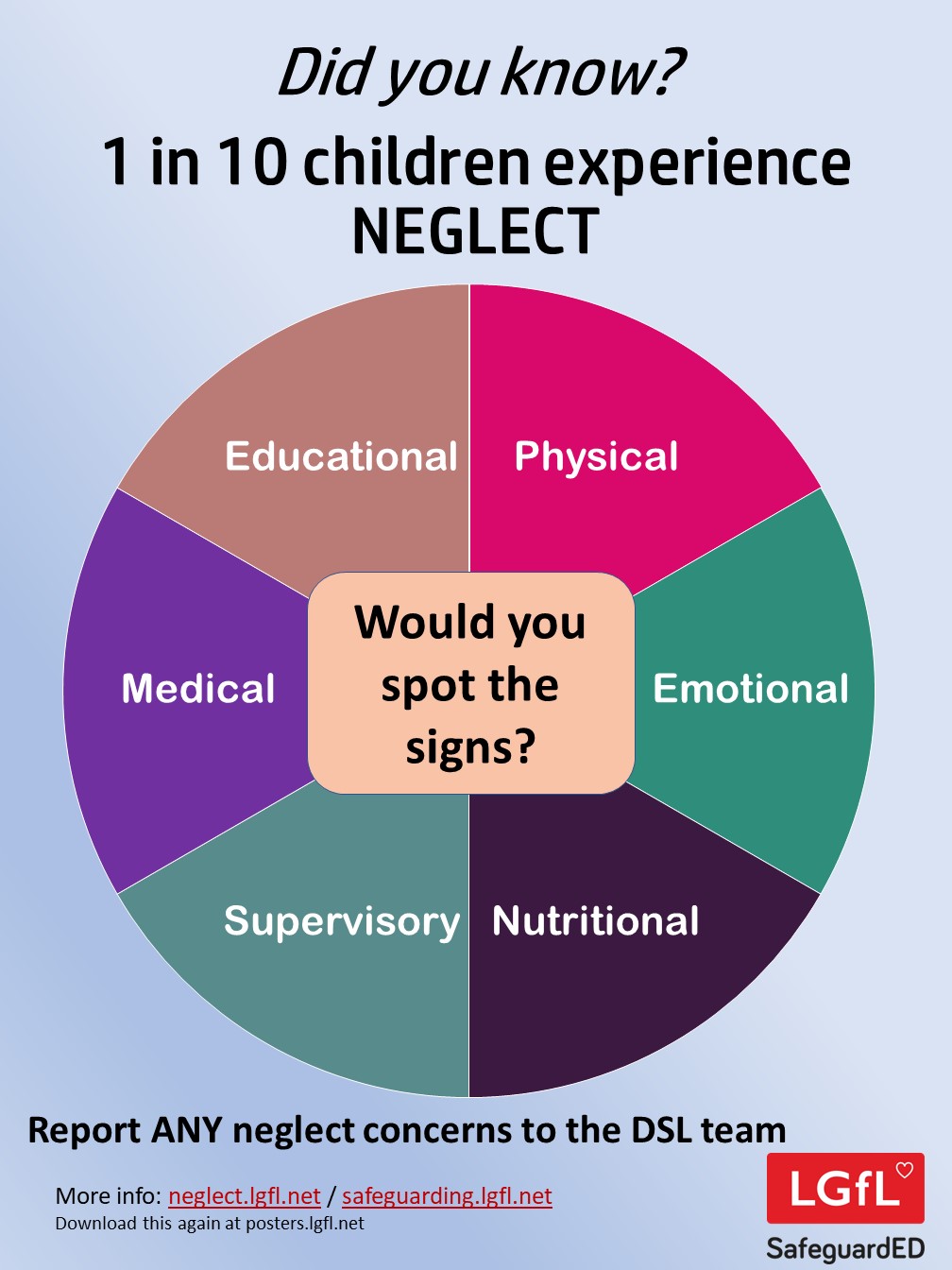
It’s difficult to measure exactly how many children in the UK experience neglect. However, research with 2,275 young people aged 11-17 about their experiences of neglect suggests around 1 in 10 children in the UK have been neglected (NSPCC).
" I took an overdose as I felt there was no way out. I wanted them to listen to me" (Taken from Sophie's story, NSPCC).
**Please note- ESAS regularly update the SLN however it is the responsibility of education professionals to ensure that the information (guidance, resources, posters etc) that are used are up to date and relevant**
Guidance, training and learning
Guidance
Staffordshire specific guidance
The Staffordshire safeguarding children partnership (SSCP) themed priority for 2022-2025 continues to be neglect with a specific focus on infants under one.
- SSCP Child neglect screening tool. This Screening Tool should be used in all cases where neglect is suspected and will aid practitioners in deciding whether a Graded Care Profile 2 (GCP2) tool should be completed.
- ESAS Graded care profile 7 minute briefing
- ESAS Child's voice crib sheet
- Threshold Framework 2023 - Staffordshire Safeguarding Children Partnership (staffsscp.org.uk)
- SSCP Escalation Policy - Staffordshire Safeguarding Children Partnership (staffsscp.org.uk)
Other guidance
In addition to statutory guidance:
Attendance
- Working together to improve school attendance (publishing.service.gov.uk)- point 87 educational neglect
Hoarding
- Hoarding Clutter image ratings
- Hoarding Staffordshire fire service
Supervision
General
Training
Learning
- Published Child Safeguarding Practice Reviews - Staffordshire Safeguarding Children Partnership (staffsscp.org.uk)
- Birmingham Serious case review- Hakeem Hussain who died of an asthma attack.
- Neglect: learning from case reviews | NSPCC Learning.
- NSPCC - Hidden men:learning from case reviews.
What is neglect?
Neglect is defined as the persistent failure to meet a child’s basic physical and/or psychological needs, likely to result in the serious impairment of the child’s health or development.
All ages of children can experience neglect including adolescents.
There are four categories of neglect; physical, educational, emotional and medical.
Neglect may involve a parent or carer failing to:
- provide adequate food, clothing and shelter (including exclusion from home or abandonment)
- protect a child from physical and emotional harm or danger
- ensure adequate supervision (including the use of inadequate care givers)
- ensure access to appropriate medical care or treatment
- provide for a child’s basic emotional needs (unresponsiveness)
Physical indicators of neglect
These include:
- Constant hunger
- Poor personal hygiene
- Poor dental health
- Skin rashes, lice etc
- Constant tiredness
- Inadequate and/or dirty ill- fitting clothing
- Untreated medical problems
- Under/overweight
Behavioural indicators of neglect
These include:
- Social isolation
- Low self-esteem
- Frequent lateness or nonattendance at school
- Missed medical /dental appointments
- Destructive tendencies
- Poor relationships with peers
- Compulsive stealing/scavenging
Responding to concerns about neglect
- Where a child is at risk of significant harm or has come to significant harm, Staffordshire families integrated front door (SFIFD) should be contacted 0300 111 8007.
Early identification of the signs that neglect may be occurring is crucial and will enable the right support to be put in place to prevent further chronic neglect.
- Where a child is not at significant risk of harm, settings should work with families to try and address neglect, including using the GCP2 tool.
- Consider what your concerns are - What evidence do you have? When did these concerns arise? What signs are you seeing which indicate neglect? What is the impact on the child?
- Speak to the child - Consider what their lived experience is. Complete direct work with the child, to get an understanding of home life, routines and boundaries.
- Speak to parent/carer - Explore the concerns and try to gain an understanding of their views. Do they have the same concerns? Is there any explanation for what you are seeing? How do they feel they can respond to the concerns? Remember to also discuss strengths as well as concerns.
- Speak to other agencies - If there are siblings which attend another setting, link up with the DSL to ascertain if they have the same concerns for the child in their setting and actions taken.
- Consider the impact of the neglect on the child. What is likely to happen if the situation does not improve? What is the current impact?
- Consult the threshold framework to determine the right level of action.
- Start a Graded care profile 2 (GCP2)- Where the threshold has not been met for S47, settings should start a GCP2.
- Discuss earliest/early help with the family, signposting to other services such as the school nurse service.
- Review progress - Agree with parents when together you will review the situation. Be clear about what would be an indicator of change.
- If there is not any progress and the family will not consent to services or GCP2, settings can complete the GCP2 on professional judgement to inform their decision making.
The NSPCC Graded care profile 2 tool (GCP2)
If you are unsure if a GCP2 should be started, complete a child neglect screening tool to determine if it is appropriate.
The graded care profile 2 (GCP2)
- It is an evidence-based assessment tool, for measuring the quality of care provided by a parent or carers in meeting their child’s needs.
- The tool uses a graded scale from 1 to 5 by capturing levels of physical and emotional care through the eyes of the child.
- It is intended to be used with consent with families .
- Identifies where children require further support and whether the level of care received needs to be improves.
- Implements a constructive working relationship with families.
- Increase confidence in decision making.
- Promotes multi-agency working.
If on completion it is determined the family meet 4/ 5 on the scale, there should be consideration to a referral to the Staffordshire families integrated front door 0300 111 8007. The GCP2 should be referred to, as evidence to support your referral.
Accessing the GCP2
To access the graded care profile 2, settings will need to complete the SSCP training course. You will then receive access to an online portal where you can access the documents.
Support and services for children, families and professonals
Support services for children and their families
The support offered to children and their families, will depend on the type of neglect and the impact on the child. Services could include:
- School nurse referrals
- Staffordshire family hubs - Family hubs bring together different services for families, to make it easier for families to get the help you they need.They provide a single place to go for face-to-face support and information from a variety of services.
- Chat health is a messaging service for young people aged 11-19 years and for parents and carers of children aged 5-19.
- Childline
- Young carers
- Mental health and emotional wellbeing services
Child and parent guides
Child guides
- Neglect matters NSPCC guide or 11–17 year-olds which tells young people what neglect is, how to recognise it, who they can turn to for help
- How often should you wash yourself - and your things? - BBC Bitesize
- Eat well - NHS (www.nhs.uk)
Parent guides
- Neglect matters NSPCC parent, carer and professionals guide (Remove page 13 and 15)
- Managing challenging behaviour - Family Action (family-action.org.uk)
- Challenging behaviour | Family Lives
- Children's teeth NSPCC guidance
- Barnados healthy lifestyles, diet, exercise and sleep- 13-16 year olds
- Learning to talk | 3 to 5 years | Start for Life (www.nhs.uk)
- Barnardos five to thrive guidance
- Barnardos understanding and responding to behaviour 4-8 year olds
- Barnardos routines and behaviour guidance -8-12 year olds
Home safety
- Safe at home, home safety advice by child injury prevention
- Safe sleeping campaign- In order to help parents reduce the risk of SIDS.
- Blind cords campaign -At least 35 young children across the UK have died because of looped cords on blinds since 2001
- Magnets safety | Top tips to keep children safe
- NSPCC home or out alone guide for parents/carers- This guide provides practical tips and advice to help parents and carers decide what is best for their child when it comes to staying home alone or going out alone.
Advice services and resources for education professionals
- School nurse hub
- Natalie McGrath PSHE Education Staffordshire - For enquiries around PSHE and resources.
- Effective practice development officers - For support with early help, training and local services.
- ESAS 01785 895836
Posters
Further information
Educational neglect
- ESAS 7 minute briefing educational neglect
- Child not seen checklist
Where a parent does not ensure that their compulsory school age child receives efficient full-time education.
Working together to improve school attendance guidance states 'If all avenues of support have been facilitated by schools, local authorities, and other partners, and the appropriate educational support or placements (e.g. an education, health and care plan) have been provided but severe absence for unauthorised reasons continues, it is likely to constitute neglect'.
Settings should:
- Follow your attendance processes and refer to Staffordshire education welfare statutory action when appropriate.
- Offer early help when attendance first begins to decline.
- Start a GCP2. This should be with consent of the family and working with them. Where the family will not consent and the threshold has been met to make a referral to SCAS, a GCP2 should be completed using professional judgement. Where referrals which do not meet S47 threshold, SCAS will ask for settings to complete a GCP2 prior to the referral to SCAS.
- Exhaust all avenues to try and engage parent/carer/child to improve attendance.
- Consider barriers to attending and make appropriate referrals to services.
- Document all actions taken to address attendance. If it is that a referral is made to SCAS, the evidence will be crucial to decision making.
- Where parents are separated and there are not safeguarding concerns, both parents should be contacted and involved in any discussions.
Adolescent neglect
Research suggests that professionals are not as effective at identifying neglect in older children, compared to younger children. The impact of neglect on the outcomes and development of adolescents can be longstanding and significant. In 2018 Ofsted stated that there needed to be a 'greater awareness of the neglect of older children and a focus on trauma-based approaches to tackling it' (LGfL).
Affluent neglect
Affluent neglect refers to the neglect experienced by children in wealthy families. Often this neglect can be more difficult to spot, as the type of neglect experienced by children and young people is often emotional (TES).
- Spotlight on Safeguarding - Affluent Neglect Case Study 1 (youtube.com)
- Spotlight on Safeguarding - Affluent Neglect Case Study 2 (youtube.com)
- handling-cases-of-affluent-neglect-in-schools.pdf (farrer.co.uk)
- Affluent neglect training
Childhood obesity
Some obesity in children will be due to neglect.
Obesity is associated with poor psychological and emotional health, and many children experience bullying linked to their weight. Children living with obesity are more likely to become adults living with obesity and have a higher risk of morbidity, disability and premature mortality in adulthood.
In the 2018 to 2019 school year, around three-quarters, or 76.5%, of children in reception (4 and 5 years old) were a healthy weight. In year 6, around two-thirds, or 64.3% of children (10 and 11 years old), were a healthy weight. Overweight and obesity prevalence (including severe obesity) was higher in year 6 (34.3%) compared to reception (22.6%) Gov.UK
Important message - Please notify ESAS by email of any change to your DSL or DDSL contact details. It is crucial that these details are up to date, to ensure that you receive updates and invites.